Expert Office 365 Familu & Enterprise Migration Services
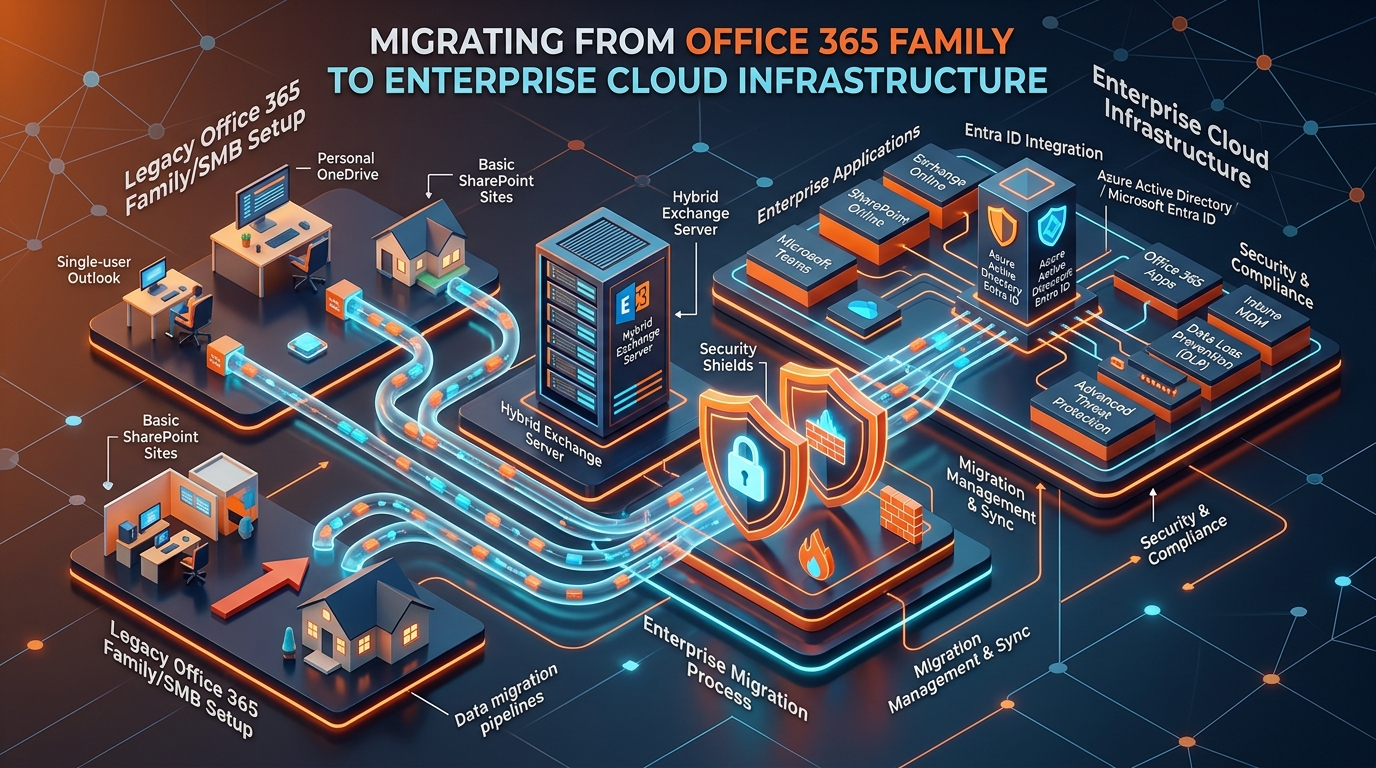
Figure 1: Enterprise Office 365 Family to Enterprise Tenant Migration Architecture.
Introduction: Moving Beyond Basic Setups
In today’s hyper-connected, digital-first business landscape, agility, security, and scalability are not just buzzwords—they are the fundamental pillars of survival. Many small business owners and startup founders begin their journey by searching for an office 365 familu (Family) plan to cover basic collaboration needs. However, as organizations scale, the limitations of consumer-grade infrastructure become glaring bottlenecks. For IT Directors, CTOs, and Enterprise Operations Managers, the mandate is clear: transitioning from basic setups to a robust, enterprise-grade Microsoft 365 environment is a critical business imperative.
Executing a flawless enterprise tenant migration requires much more than simply moving data from point A to point B. It requires meticulous planning, deep technical expertise, and an unwavering commitment to cybersecurity. A botched migration can result in catastrophic downtime, permanent data loss, and severe regulatory compliance breaches. This is exactly why organizations must transition away from legacy systems and consumer plans, engaging a certified cloud migration provider to architect and execute a seamless digital transformation.
This masterclass guide delves deep into the technical architectures, deployment strategies, and security protocols required for a successful enterprise migration. We will explore how to evaluate and select the right m365 deployment partner, the nuances of advanced email migration solutions, and the steps required to ensure a zero-downtime transition for your global workforce.
The Imperative for an Expert Cloud Migration Provider
When transitioning from an on-premises Exchange Server or a basic office 365 familu subscription to an Enterprise Microsoft 365 tenant, the technical complexity scales exponentially. The risks associated with data corruption, routing loops, and credential mismanagement demand the oversight of a specialized professional.
Overcoming Exchange to Microsoft 365 Migration Complexities
An exchange to microsoft 365 migration is rarely a linear process. Legacy on-premises environments are often burdened with years of customized routing rules, complex public folder structures, shared mailboxes, and integrated third-party applications (such as CRM systems, ERPs, and automated ticketing tools) that rely on SMTP relay.
When executing an enterprise migration, the architect must ensure that Mailbox Replication Services (MRS) are properly configured to handle the throughput without disrupting active user sessions. Bandwidth throttling, firewall configurations, and legacy authentication protocols (like Basic Authentication) must be carefully audited and remediated. A certified partner brings specialized diagnostic tools to pre-scan the environment, identifying corrupted items, oversized mailboxes, and unsupported characters in file names before the synchronization process even begins.
Avoiding Data Loss and Compliance Breaches
For enterprise organizations operating in regulated industries such as healthcare, finance, or government contracting, data sovereignty and compliance are non-negotiable. Moving to the cloud involves transferring highly sensitive Personally Identifiable Information (PII), Protected Health Information (PHI), and intellectual property.
Compliance Warning: Without a master cloud architect managing the process, organizations risk exposing their data during transit. Expert migration providers utilize robust encryption protocols (TLS 1.2+) and establish secure VPN tunnels or ExpressRoute connections to Microsoft data centers. Furthermore, they implement advanced data loss prevention (DLP) policies and retention tags in the target tenant prior to the cutover, ensuring that regulatory compliance is maintained continuously from the legacy environment to the cloud.
Technical Architecture of an Enterprise Tenant Migration
An effective enterprise tenant migration requires a phased, architecturally sound approach. The process must be invisible to the end-user, culminating in a seamless switch where employees log in on Monday morning with full access to their data, unaware of the complex backend engineering that occurred over the weekend.
Source Environment Discovery and Analysis
The foundation of any successful migration is a comprehensive discovery phase. This involves mapping out the entire source infrastructure:
- Active Directory Health Check: Ensuring AD is clean, free of orphaned objects, and properly configured for Azure AD Connect.
- Mailbox Profiling: Analyzing mailbox sizes, item counts, and identifying archives that exceed standard limits.
- Network Readiness Assessment: Calculating the necessary bandwidth required to move terabytes of data within the designated cutover window.
- Application Dependency Mapping: Identifying every application, script, and multi-function printer that relies on the current email infrastructure.
Identity Synchronization and Active Directory Integration
In an enterprise context, identity is the new security perimeter. A seamless user experience relies on single sign-on (SSO) and synchronized identities. The deployment partner will configure Azure Active Directory (Azure AD) Connect to synchronize on-premises AD identities with Microsoft 365.
This phase includes configuring Password Hash Synchronization (PHS) or Pass-Through Authentication (PTA), depending on the organization's security posture. For highly complex environments, Active Directory Federation Services (AD FS) may be required to maintain strict on-premises control over the authentication process. Ensuring that User Principal Names (UPNs) match the primary SMTP addresses is a critical step that prevents login failures and access issues post-migration.
Advanced Email Migration Solutions
Selecting the correct migration topology is arguably the most critical decision a CTO will make during this process. The chosen email migration solutions dictate the project timeline, user impact, and coexistence capabilities.
Cutover vs. Staged vs. Hybrid Topologies
- Cutover Migration: Best suited for smaller organizations (typically under 150 users) looking to move away from legacy systems or consumer setups like an office 365 familu plan. All mailboxes, contacts, and distribution groups are migrated over a single weekend. While fast, it requires rebuilding Outlook profiles for all users simultaneously.
- Staged Migration: Designed for legacy Exchange environments (Exchange 2003 or 2007) where a hybrid setup is not possible. Users are migrated in batches over time. However, this method requires maintaining dual environments and complex forwarding rules.
- Full Hybrid Migration: The gold standard for mid-to-large enterprises running Exchange 2013, 2016, or 2019. A Hybrid Configuration Wizard (HCW) is executed, establishing an organizational relationship between the on-premises server and the Microsoft 365 tenant. This allows for seamless cross-premises free/busy calendar sharing, unified global address lists (GAL), and the ability to seamlessly offboard mailboxes if necessary. Users do not need to recreate their Outlook profiles, resulting in zero downtime.
Handling Legacy Data: The PST Challenge
One of the biggest hurdles in any migration is dealing with decades of decentralized data, specifically PST (Personal Storage Table) files scattered across local hard drives and network file shares. These files are highly prone to corruption, represent a massive security risk, and bypass corporate retention policies.
A professional migration strategy must include the discovery, ingestion, and centralization of these legacy files into Microsoft 365 Online Archives. For a deep technical walkthrough on how to execute this specific phase utilizing network upload or drive shipping methods, review our comprehensive Import PST to Office 365 Guide.
Why Choose a Certified M365 Deployment Partner?
Many IT departments attempt to execute cloud migrations internally to save costs. However, standard IT teams are primarily focused on maintaining day-to-day operations ("keeping the lights on"). Cloud migrations are specialized, high-risk projects that require niche expertise and daily familiarity with Microsoft's constantly evolving backend PowerShell modules and APIs.
Partnering with a certified m365 deployment partner ensures that your internal IT team is not overwhelmed, allowing them to focus on strategic business initiatives while the migration experts handle the heavy lifting. To understand the full scope of what a specialized consultant brings to the table, including licensing optimization and long-term strategic roadmapping, read our detailed Microsoft Office 365 Consultant Guide.
Data Comparison: Internal IT vs. Certified Migration Partner
| Capability | Internal IT Department | Certified M365 Deployment Partner |
|---|---|---|
| Migration Experience | Once every 5-7 years. | Daily execution across diverse industries. |
| Tooling & Automation | Reliance on native, manual tools. | Access to enterprise-grade, proprietary migration toolsets (e.g., BitTitan, Sharegate). |
| Downtime Risk | High. Troubleshooting is done on the fly. | Near-Zero. Extensive pre-migration testing and hybrid architectures. |
| Security Hardening | Basic default configurations. | Implementation of Zero-Trust architecture, Conditional Access, and Intune MDM. |
| Licensing Optimization | Often over-procured or under-utilized. | Strategic mapping of licenses (E3/E5) to actual user personas, saving costs. |
Evaluation Checklist: Hiring the Right Partner
When CTOs and Business Owners are evaluating potential partners for their enterprise tenant migration, they must look beyond basic marketing claims. Use the following rigorous evaluation checklist to ensure the provider has the technical depth and operational maturity required for your project:
- Verify Microsoft Designations: Do they hold advanced Microsoft Solutions Partner designations (formerly Gold Competencies) in Modern Work and Security?
- Request Architectural Blueprints: Can they provide anonymized architectural diagrams of previous hybrid migrations they have completed?
- Assess Automation Capabilities: Do they utilize advanced PowerShell scripting and Microsoft Graph API for bulk user provisioning and configuration, or do they rely on manual GUI clicks?
- Review the Testing Protocol: Do they offer a comprehensive User Acceptance Testing (UAT) phase with pilot user groups before the main velocity migration?
- Examine Security Posture Integration: Will they simply move your data, or will they deploy Defender for Office 365, configure SPF/DKIM/DMARC, and set up Conditional Access policies as part of the migration scope?
- Evaluate Change Management: Do they provide end-user training, communication templates, and adoption strategies to ensure your workforce maximizes the ROI of the new platform?
- Check Post-Migration Support SLAs: What is their Service Level Agreement for post-migration hypercare and ongoing managed services?
Securing Your Investment Post-Migration
A successful migration is just the beginning of your cloud journey. Once the data resides in Microsoft 365, the focus must immediately shift to security, governance, and compliance hardening. The default security settings in an out-of-the-box tenant are entirely insufficient for a modern enterprise facing sophisticated phishing, ransomware, and insider threats.
Zero-Trust and M365 Hardening
A premier cloud architect will implement a Zero-Trust security model. This involves several advanced technical configurations:
- Conditional Access Policies: Restricting access based on user location, device compliance state, and real-time risk calculations provided by Azure AD Identity Protection.
- Mobile Device Management (MDM): Deploying Microsoft Intune to enforce corporate security baselines on all endpoints (Windows, macOS, iOS, and Android), ensuring that corporate data can be wiped remotely if a device is lost.
- Email Authentication and Threat Protection: Enforcing strict SPF, DKIM, and DMARC records to prevent domain spoofing. Deploying Microsoft Defender for Office 365 to provide Safe Links and Safe Attachments, neutralizing malicious payloads in real-time.
- Information Protection: Utilizing Azure Information Protection (AIP) to classify, label, and encrypt sensitive documents, ensuring that even if a file is exfiltrated, it cannot be opened by unauthorized parties.
Conclusion & Next Steps
Upgrading from consumer solutions like an office 365 familu subscription or escaping the limitations of aging on-premises Exchange servers is a defining moment for any growing enterprise. The transition to a modern, secure, and highly collaborative Microsoft 365 environment unlocks unparalleled productivity and agility.
However, the path to the cloud is fraught with technical pitfalls, security risks, and potential operational disruptions. Trusting this critical transformation to anyone less than an elite, certified cloud migration provider is a risk your business cannot afford to take. By leveraging advanced email migration solutions, hybrid architectures, and rigorous security hardening, a master deployment partner ensures a flawless, zero-downtime transition that safeguards your most valuable asset: your data.
Are you ready to secure your business's future and execute a flawless migration?
- Explore our comprehensive, enterprise-ready Office 365 Package & Pricing to find the exact service tier your organization requires.
- For more deep-dive technical insights, architectural guides, and industry best practices, bookmark the Work365 Knowledge Base.
Do not let legacy technology hold your enterprise back. Engage with an elite migration architect today and transform your IT infrastructure into a strategic business advantage.
Get Genuine Office 365 Pack for $10
Unlock full desktop applications, 1TB OneDrive cloud storage, and 1-year full warranty.
Order $10 Pack via WhatsApp